

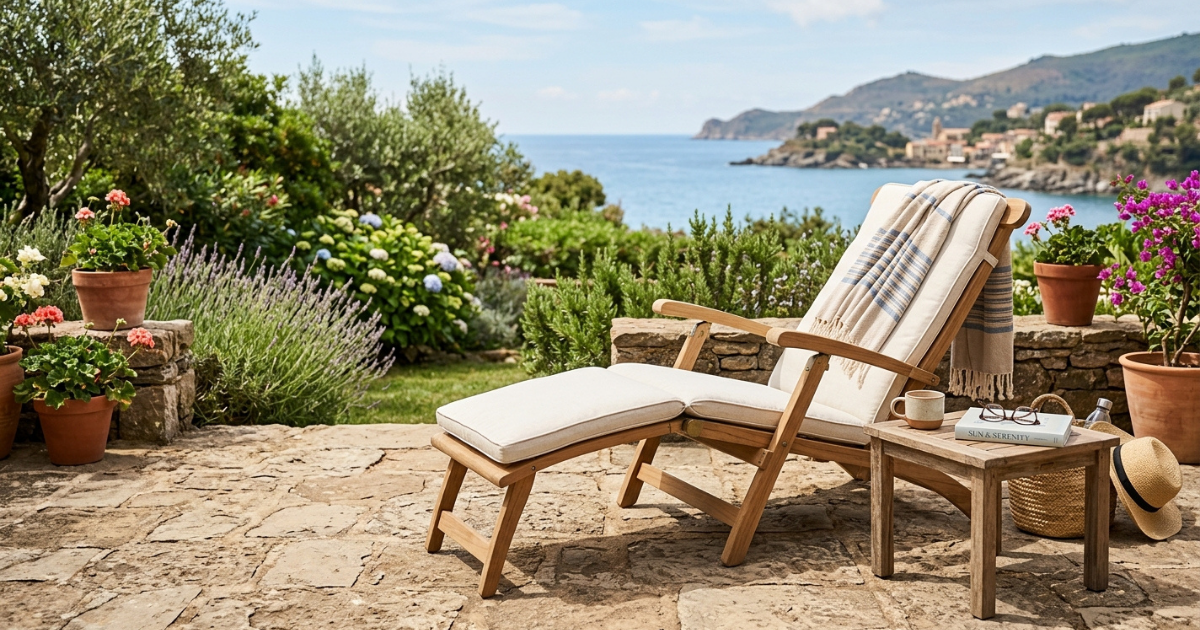
Picture a slow Sunday afternoon. You have a cold drink, a book you keep meaning to finish, and a lounger that lets you lie all the way back. A good wooden lounger quickly becomes the most fought-over seat at your place. A bad one gets dragged into the garage by August and forgotten.
The difference usually comes down to four things: the wood, the size, the comfort, and how well it handles the weather. You don't need to be an expert to get all four right.
Start with the wood
Wood behaves differently outdoors, so this choice is a trade-off between price, looks, and how much upkeep you're willing to do.
Teak is the low-fuss option. It's naturally full of oils that keep out water, bugs, and rot, so it can live outside for years with very little care. It starts as a warm honey-gold and, if you leave it alone, slowly fades to a soft silvery grey. It costs more up front, but you're paying for a lounger you won't have to think about. The Curated Maison Edgard reclining teak lounger is a good example. It has open slats so rain drains straight through, wheels so you can roll it out of the shade, and a slide-out shelf for your drink.
Eucalyptus is the friendlier-on-the-wallet choice, with a warm, natural look. It needs a little more love, usually a coat of outdoor sealer or oil once or twice a year, to keep it from drying out and fading quickly. It suits lighter use, or people who can tuck it away for winter. A light, folding piece like the Vifah reclining eucalyptus lounge chair is easy to carry and store, which helps if you're working with a small patio or balcony.
Acacia sits in the middle. It's dense, sturdy, and has a rich color, and like eucalyptus it likes a yearly oiling.
Cedar and redwood are lightweight and smell wonderful, and both naturally resist bugs and rot. They're softer, so they pick up dings and scratches more easily. Plenty of people think that adds to the cabin-by-the-lake charm.
A simple rule: the less maintenance you want to do, the more it's worth spending on the wood.
Get the size right before you fall for a photo
Loungers always look smaller in pictures. Before you buy:
-
Measure your space. Many full-length loungers stretch about 6½ feet when laid back and are roughly 2 feet wide. Then add walking room around it (about 3 feet feels comfortable) and space for a small side table.
-
Think about who's using it. If you're tall, check the length so your feet don't hang off the end. Look at the weight limit too. And note the seat height: low loungers feel cozy but can be harder to climb out of.
-
Think about where it will live. A big pool deck can handle a full-size lounger. A balcony or small patio is better off with something compact that folds away.
-
Planning to share? Two single loungers usually work better than one big double. You can angle them however you like, and moving them is easier.
Comfort: lie back and try it
A lounger can look perfect and still be uncomfortable. If you can test one in person, or read reviews closely, look for these:
-
Recline settings. More positions means more uses: upright for reading, halfway for chatting, flat for a nap. Make sure it locks firmly in each spot.
-
Support that fits your body. Lie back for a full minute. Does your head rest comfortably? Do your knees bend naturally? Are your arms happy, with or without armrests?
-
Cushions. Slatted wood is firm on its own, which some people love. If you want something softer, choose quick-drying outdoor cushions you can take off and store.
-
Handy extras. Wheels let you chase the sun, a side shelf keeps your drink close, and a folding frame makes winter storage easy.
Weather protection: how to make it last
Outdoor furniture doesn't have to be babied, but a few small habits go a long way.
Let the rain run through. Slatted seats and backs let water drain instead of pooling. Set your lounger on a dry, level surface like a deck or pavers rather than damp grass.
Don't panic about sun fading. Sun turns most wood a silvery grey. It's purely cosmetic, and many people like the look. If you'd rather keep the golden tone, wipe on a UV-protective oil or sealer at the start of each season.
Check the hardware. Screws and hinges should be stainless steel or brass so they don't rust and leave streaks on your wood.
Cover it when the weather turns. In rainy or snowy months, a fitted, breathable cover and a dry place for your cushions make a big difference. Skip plastic tarps, which trap moisture and invite mildew. You can find covers and cushions made for exactly this.
Keep the cleaning simple. A soft brush, mild soap, and water are enough. Let it dry in the sun afterward. The same routine handles most spots of mildew.
A quick checklist before you buy
-
Does the wood match how much upkeep you're willing to do?
-
Have you measured your space, including walking room?
-
Does it have a few solid recline positions, and does it feel good when you lie back?
-
Are the seat and back slatted for drainage, with rust-proof hardware?
-
Do you have a plan for covers and cushion storage?
A good wooden lounger is really an excuse to slow down. Pick a wood that suits your patience, a size that suits your space, and give it a little protection. It should be the seat everyone claims first for years to come.